

Iterative Solo Play
and The Baron's Grip on BackerKit and other Updates

I played a game again. I played a game that I had already played, again. But it was the same game. Not just the same game, but the same game of the same game.
Yeah, that’s easier to explain out loud than in writing.
I recently played Thousand Empty Light for a second time, but not as a completely new game — as an extension of the original game that I played over a year ago with a new character. And it was awesome.
Inside
Iterative Solo Play
PAXU 2025
November Production Update
Iterative Solo Play
In one of my earliest posts on Ink & Dice, I talked about the solo system in Thousand Empty Light, a module by Alfred Valley for Mothership. This was one of my first experiences using oracles to play a multiplayer TTRPG as a solo player, and it really opened my eyes to the possibilities of that medium.
Recently, Chris Air discussed Thousand Empty Light with David and Daniel of Copy/Paste’s Substack on his new podcast Ansible Uplink. Listening to them talk about the game reminded me of how eye-opening this game was, so I brought it back out.
A Second Run
Feeling inspired, I decided to give it another play, but this time with a twist: I dug up my original play-through, and I used my old game to create a new set of entries in the MemoComm modules. It was interesting how little I remembered of that game, but I did not let my time reviewing the entries bring back too much of it. I pulled together what the MemoComm would show, how my previous character’s exploits had altered the station (there was a bit of a fire last time), and rolled a d10 for the number of weeks that had passed since that character had perished (a d10 because it’s Mothership, and weeks because in the booklet there are a bunch names of fallen lamplighters listed in the opening letter, but it comments that it’s only been 5 years that Hazmos has been managing TEL 022).
This worked great. On the one hand, my new character had a very different experience from my previous character, as I rolled different encounters in each zone of the adventure. On the other hand, my new character had a very similar experience, as the horrors they faced were worsened by the evidence that this had happened to many people before them, and they were also added to the list of lamplighters lost on TEL 022 by the end of the game.
Key Takeaways
When I talk to people about my solo games, the question of replayability often comes up. For some games, I can wholeheartedly report that replayability is the point. That’s Godspark, and that’s why I produced a tear-off pad of play sheets for that game. The design of that game is that you won’t “win” every time, and you’ll want to keep playing until you do.
But for lots of solo games, particularly journaling games, I hesitate to really say that they have high replayability. Sure, you’re going to get different prompts with each play-through of Unhallowed, but it’s still a story of running through a dark forest and witnessing terrible things. The same goes for Stork Raven Madge.
This play of Thousand Empty Light however, was something else entirely. This was not me just playing the game again. Granted, enough time had passed (about 18 months?), that I didn’t really remember my first play. I could have just played again and had a good time. But putting this game in the future of my other game brought a layer of depth to the game that really enhanced the experience. I didn’t play the game again — I continued my last game with a new character in the same space experiencing similar, but different, events. It was amazing.
Going Forward
How can I apply this experience to other games? Sure, you could play a second round of Stork Raven Madge as if it’s the next year and you’re a new researcher that has similar issues as your first one did. But that game was not designed for that, so it feels like a bit (or more than a bit) of a stretch. Thousand Empty Light was not designed for this either, which was why I had to do some legwork to figure out how to build those MemoComm entries from my old play report.
But what if this arrangement was planned in from the beginning? How could I do that? Here are a few ideas that come to mind:
While not required, a journaling/record-keeping component to the game would make it easier to leave a trail of information for the next character to find.
The MemoComm worked really well for this in Thousand Empty Light, but I had to create those entries after the fact, as my play report was a mix of text that would go into the MemoComm and text describing actions and rolls that did not belong in the MemoComm.
If the play procedure is designed to set up the world for future plays, this will save the player that extra work between games. Solo games in particular often come with well-developed procedures, so it would not be a big jump to add a step that says “now write the entry that your character adds to the public record.”
There should be events that can occur or actions that the character can perform that alter the environment in a lasting way.
In my second game of Thousand Empty Light, I encountered the site of the fire that started during my first game. However, many of the events in Thousand Empty Light do not lend themselves to such long-term effects.
Incorporating more events that do this would give that second play more interaction with the first.
There should be a reason (or a table of reasons) for another character to come along later.
Thousand Empty Light is perfect for this, as it sets up right away that lamplighters get sent to this location repeatedly.
Adding a list of hooks, and using a different one each time, will add variability that will help with making each run of the game a new experience.
There needs to be a wide variety of events that can occur during play.
While it might make sense for multiple characters going through a particular location to have similar experiences, this might get boring for the player. The more variety of events, the more engaging those subsequent plays will be.
It might even be helpful to have different sets of events. Maybe the actions of the first character determine which tables are used to select events for the next character. This would be a cool sort of meta-agency for the player, making the consequences of their decisions play out across multiple characters.
Anyway, I don’t have an idea (yet) for this journaling game that is designed for multiple play-throughs by a single player playing multiple characters separated in time, but I think it would be cool. If anyone knows of any games like this, drop them in the comments!
(I also had a conversation with some game designers recently about generational curses, based on an infomercial I happened to watch by accident, and this feels like a setup that could support that as a mechanism. More later, maybe.)
PAXU 2025
I’m headed back to Philadelphia this week for PAX Unplugged 2025. This is my biggest show each year, and I am very excited to be returning again. I’ll be in the same booth as last year, 4303, so if you are going to be in Philadelphia this weekend, stop by and say hello!

November Production Update
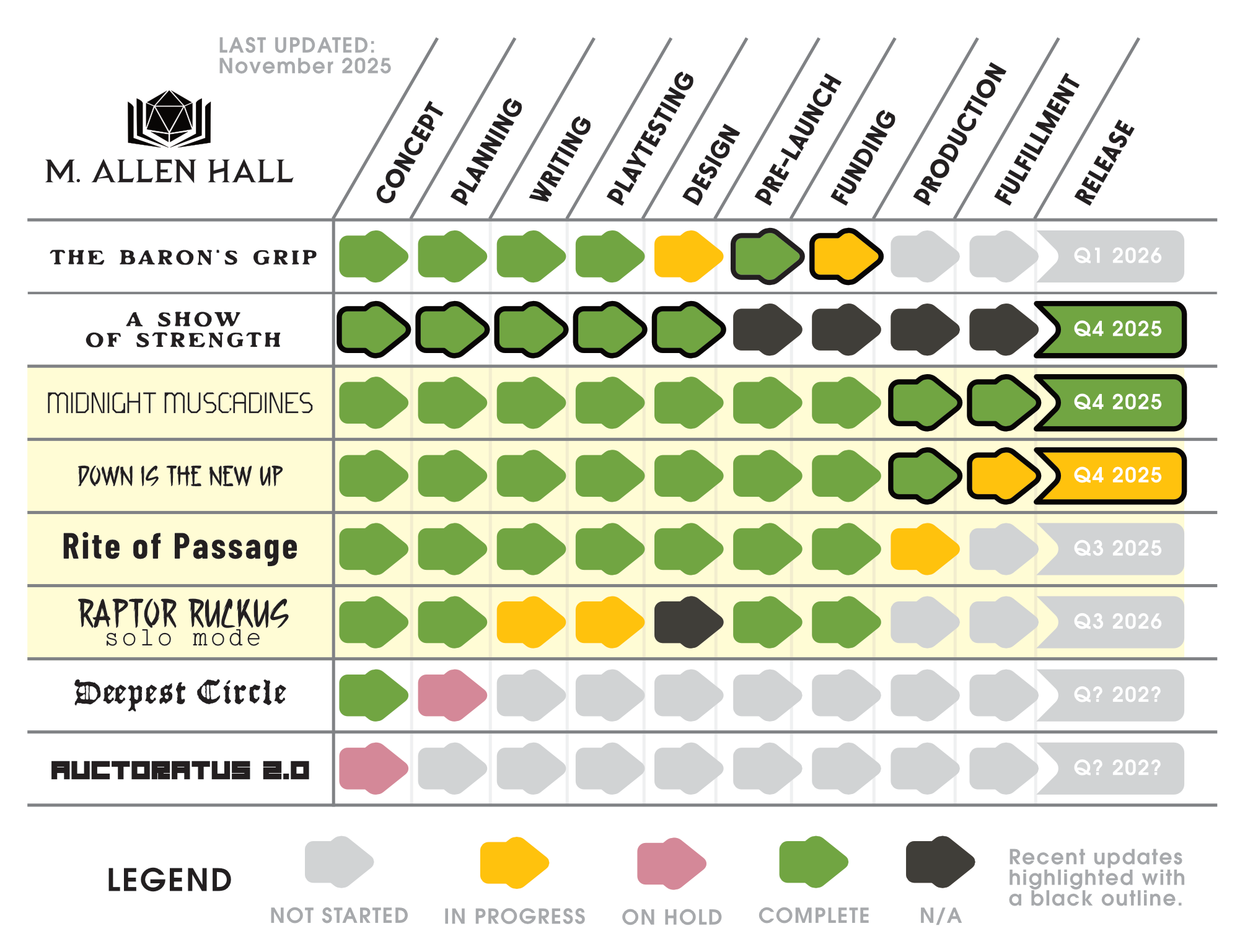
I’ve been head-down on work for The Baron’s Grip these past few weeks, but I managed to take some time to put together a pamphlet adventure for Mausritter. I did this both so that I could submit something to the Mausritter Month Companion Jam on Itch and so that I would have a nice, compact, introductory adventure for the campaign in The Baron’s Grip.

Initially, I just had some suggestions for the GM for starting the campaign (ways to introduce the characters and their relationships). These will work well for some GMs and some players, but I thought it would be important to also present a very concrete adventure that could be used as a Session #1 of this campaign. This adventure can then be used by GMs that prefer to jump right into the action. The heist offers opportunities for players to find hooks for a variety of other locations in the setting, quickly giving them purpose and direction to get the campaign rolling.
Thank you
You made it all the way to the end? Again?? Well, thank you. Anyway, I’m going to get back to packing books for PAXU and not checking the BackerKit page for The Baron’s Grip for the 100th time today. Ink & Dice will be back next month!
—MAH
Final Girl uses an trick to create replayability that might be usefully coopted by solo journaling games. During set-up you randomly select one of the killer finale cards and put the rest back in the box; you deal ten of the action cards and put the rest back in the box etc. So you end up playing with a universe of potential that is a subset of the overall universe of potential for the game. Consequently, future games will be different because of the subset that is selected in that initial setup - and as a player you know that, and approach it as a game that will have novel content.
I’m really glad the pod got you back into it. It’s such an incredible piece of work.